Drinking Water · Point-of-Use
Reverse osmosis, specified properly.
Reverse osmosis is the gold standard of point-of-use water purification — when it is engineered correctly. The vast majority of installed systems are not. They are catalog-sized, post-mineralized as an afterthought, and serviced by whoever answers the dispatch line that year. Ours are not.
Chapter I · The Problem
What you cannot remove without molecular filtration.
Whole-house systems address chlorine, sediment, hardness, and most chemicals. They do not, by design, remove dissolved solids — the nitrates, fluoride, sodium, microscopic plastics, and pharmaceutical residues that pass through a carbon bed. RO is the only point-of-use technology that does.
01Total Dissolved Solids (TDS)
Typically 280 – 420 ppm in SWFL city waterThe combined concentration of every dissolved mineral, salt, and metal in your water.
Cloudy ice, off-flavors in coffee and tea, mineral buildup in espresso machines and humidifiers.
02Fluoride
0.6 – 0.8 ppmAdded by some municipalities as a public-health measure.
Acceptable for some families, unwanted by others. RO removes it entirely. The choice is yours.
03Nitrates
Variable, well water can exceed 10 ppmAgricultural and septic-system byproduct; particularly elevated in well water and shallow aquifers.
Especially concerning for infants under six months and pregnant women; linked to methemoglobinemia.
04PFAS (forever chemicals)
Persistent industrial compounds that resist conventional treatment.
Subject of active EPA regulation; linked to thyroid, cholesterol, and developmental effects.
05Microplastics
Particles under 5mm now present in nearly all bottled and tap water tested globally.
Long-term health effects under active research; RO removes them physically.
Plate I · Before
Chapter II · Diagnostics
Sized to your TDS, not to a brochure.
The most common RO failure mode is membrane fouling from undersized prefiltration. We test TDS at your kitchen sink, evaluate your incoming pressure, and specify the prefilter stages to protect the membrane for its full service life.
- 01
TDS Baseline
Establishes how hard the membrane will work.
- 02
Incoming Pressure
Below 50 psi requires a permeate pump; we install one when needed.
- 03
Chlorine Load
Free chlorine destroys RO membranes; we verify the prefilter capacity.
- 04
Tank Sizing
Sized to family size and peak draw, typically 3.2 or 4.0 gal.
“We stopped buying bottled water entirely the week it was installed. The coffee alone is worth it.”
Chapter III · The System
The Intiwater 7-Stage RO.
Seven discrete stages, each addressing a specific failure point of a 5-stage system. Built around a 75 GPD Filmtec membrane, mounted under the kitchen sink, with a dedicated faucet at the drinking station and an optional line to the refrigerator.
- ISpun polypropylene
5-Micron Sediment
Captures particulate above 5 microns to protect carbon stages.
- IICoconut shell carbon
Pre-Carbon Block
Removes chlorine and chloramines that would destroy the membrane.
- IIIGranular activated carbon
Polishing Carbon
Second-pass chlorine reduction and chemical taste cleanup before the membrane.
- IVFilmtec 75 GPD TFC
Reverse Osmosis Membrane
Removes 99.9% of dissolved solids at 0.0001 micron pore size.
- VPressurized 3.2-gal
Storage Tank
Holds purified water ready for instant draw.
- VIIn-line GAC
Post-Carbon Polish
Removes any tank-stored taste, ensures glass-clean output.
- VIICalcite + Corosex
Alkaline Remineralization
Returns essential trace minerals and raises pH to 7.5–8.0 for taste and health.
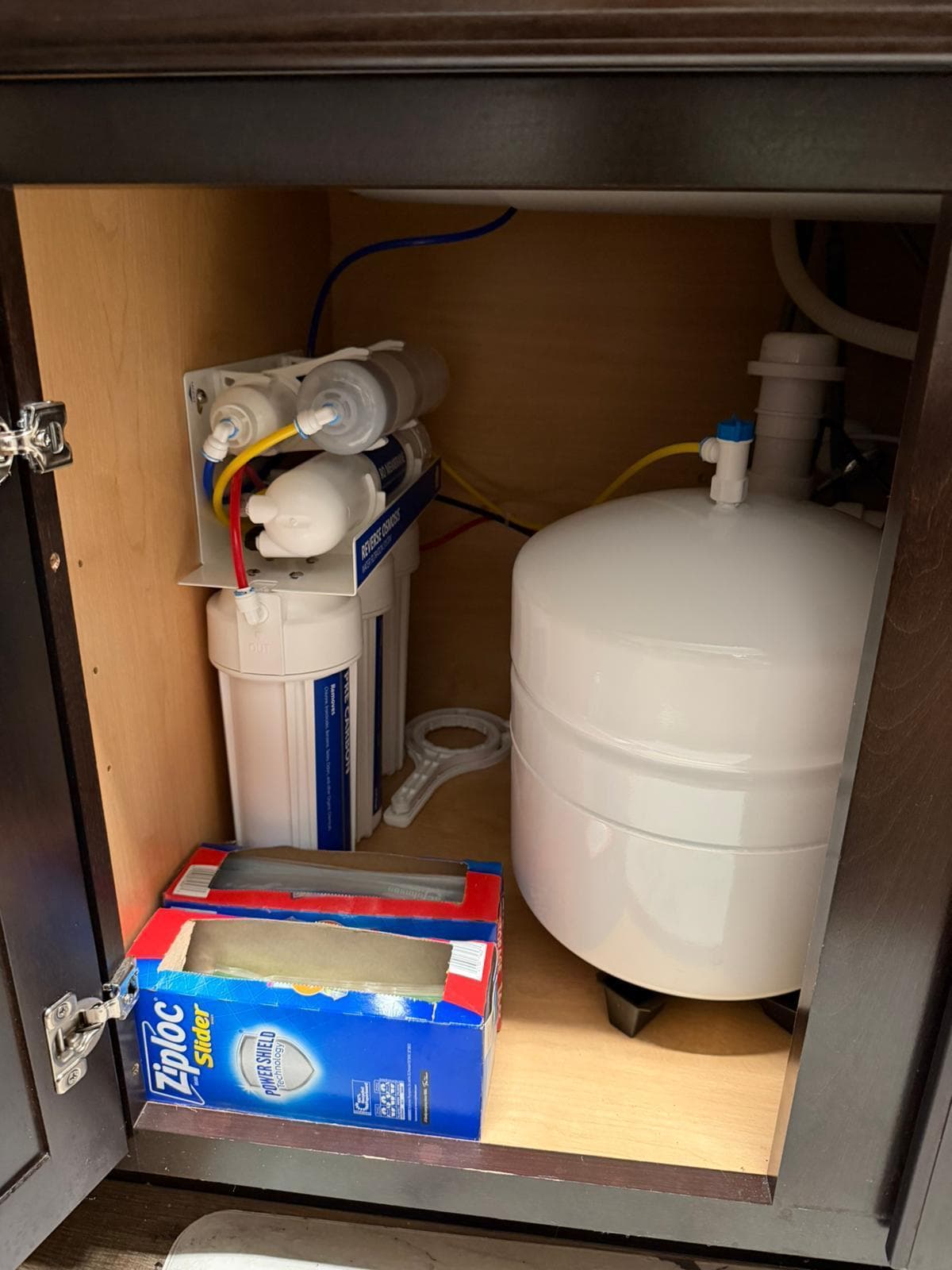
Plate II · The Installation
Installed in one day · SWFL
Specifications
Engineered to measurable tolerances.

Measurable · Tested at the tap
Chapter IV · Outcomes
Bottled-water quality from a fixed fixture.
Glass-clear ice. Coffee that tastes like the bean. The end of plastic bottles.
- 01
Stop buying bottled water.
A typical SWFL family spends $480 – $900/yr on bottled water; the RO pays for itself in the first three years.
- 02
Coffee and tea, restored.
Pour-over and espresso lift dramatically when the water TDS drops below 30 ppm.
- 03
Ice clarity.
Crystal cubes instead of cloudy. Cocktails and water carafes presentation-grade.
- 04
Baby formula peace of mind.
Pediatricians recommend RO water for formula. No nitrates, no fluoride if you wish, no chlorine.
- 05
Better-tasting food.
Rice, pasta, soup, and bread all reflect the water they're made with. RO water disappears into the food.

Plate III · After
Questions
What homeowners ask before they decide.
- Does RO remove the 'good' minerals?
- Yes — and our system re-adds them. Stage 7 remineralizes with calcite and corosex, raising pH to 7.5–8.0 and returning calcium, magnesium, and potassium in trace amounts. The result tastes like premium bottled mineral water.
- How much water does an RO waste?
- Our system runs a 1:1 efficiency ratio — one gallon to waste per gallon produced — and the waste line drains to your sink drain, where it would have ended anyway. Compared to the upstream water lost producing a plastic water bottle (3 gallons per bottle), RO is dramatically more efficient.
- Where does the unit live?
- Under your kitchen sink. The dedicated faucet sits next to your existing tap. We can also plumb a line to your refrigerator's ice maker and water dispenser at install.
- How often does it need service?
- Prefilters once a year, membrane every 2–3 years depending on TDS. Calvin schedules these proactively; you don't have to remember.
- Will it work on well water?
- Yes, with the appropriate prefilter package — typically a whole-house iron and sulfur removal stage first. We never install an RO on raw well water without the upstream protection.
The decision